
GHOSTMESHREADERS

Context endures. Possibility evolves.

GHOSTMESH / READER SEARCH

Search the published readings.

Results are limited to the public Reader articles on this site. Browse all Readers.

Type to search the public Reader articles.

GhostMesh Reader #70

A Smaller Model Can Win the Job, Not the Benchmark War

NeuralNine fine-tunes two small Qwen classifiers and reports a win over GPT-6 Luna. The interesting lesson is not a model upset. It is how much the task, evaluation and training boundary determine what winning means.

Source: NeuralNine, Fine-Tuning Small Models To Beat GPT-6 Luna, November 18, 2026. Original video. Crusoe-sponsored video.

GhostMesh verdict: Worth watching for a compact fine-tuning example. Not proof of general intelligence superiority, cost advantage, or independently reproduced results.

Publication status: Published November 20, 2026. Production release verified.

In this Reader
01

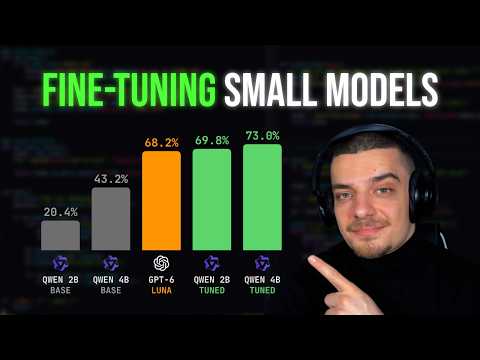
Creator-reported tuned 4B accuracy: 73.0% vs Luna 68.2% on one Shopify classification task.

02

Same evaluation items, different prompt conditions, no published paired predictions.

03

Benchmark rank, specialization and accepted-job economics are different questions.

Original video

Watch on YouTube · 12:29 · Crusoe-sponsored video · Creator's scripts

Approximate chapter-entry cues cross-checked with source frames and automatic captions. No certified transcript.

An upset with a very narrow playing field

A two-billion-parameter model can be useless for a general question and useful for the one question your business asks a million times. That is the proposition worth testing in NeuralNine's fine-tuning demonstration.

The video builds a product-category classifier from Shopify catalog data, fine-tunes two small Qwen models using Crusoe's hosted training interface, and measures their classification accuracy against an untuned GPT-6 Luna call. The creator reports that a tuned 4B model scores 73.0% compared with Luna's 68.2%. The result is interesting; the headline that small models 'beat' a frontier model needs a much narrower definition.

Reader verdict: Worth watching for a compact demonstration of the fine-tune / evaluate loop. Not evidence of a general intelligence ranking, proven cost advantage, or independently replicated model comparison. This is a Crusoe-sponsored video, as disclosed by the creator in the description and around 03:00. That relationship belongs in the evidence register, not hidden beneath the conclusion.

The experiment, reconstructed

The task is deliberately constrained: given a product title and a truncated product description, return the first two levels of its e-commerce category hierarchy. A single answer string is compared with the expected label, and accuracy is the fraction of 1,000 evaluations with an exact string match.

The public prepare.py code loads Shopify/product-catalogue train and test splits. It filters hierarchical categories and reduces category paths to two levels. The code derives eligible labels from the full training split before sampling 5,000 training products with random seed 42. It filters test items to labels found in the full training split, then samples 1,000 test products. That filter does not guarantee that every evaluated label appears among the 5,000 sampled training examples. Each sampled training example becomes an instruction / product input / category answer exchange.

The public evaluate.py code feeds the same prepared 1,000-item evaluation file to all evaluated systems. For GPT-6 Luna, the script calls OpenAI's Responses API. For the small models, it loads Qwen3.5-2B and Qwen3.5-4B, and for the tuned runs attaches separately downloaded PEFT adapters. Both the OpenAI baseline and untuned Qwen models receive the full allowed-label list. The tuned adapters instead receive a brief classification instruction without that label list.

That last detail matters. This is a practical comparison of task pipelines, not identical-prompt model capability. It does not invalidate the result, but it determines how to interpret it.

What the video actually reports

Results comparison: scroll horizontally if needed →
Creator-reported, task-specific accuracy. Not independently reproduced.
SystemCreator-reported exact-match accuracy on 1,000 items
GPT-6 Luna, untuned API call68.2%
Qwen3.5-2B, untuned20.4%
Qwen3.5-4B, untuned43.2%
Qwen3.5-2B, fine-tuned69.8%
Qwen3.5-4B, fine-tuned73.0%

The tuned 2B system is 1.6 percentage points above Luna, equal to 16 additional correct answers out of 1,000 on the same evaluation items. The video itself notes that this could be statistical noise or effectively a tie. The tuned 4B system is 4.8 percentage points above Luna, or 48 more correct answers per 1,000. These comparisons are paired by design because all systems use the same 1,000 items, but the creator published no paired per-item predictions. We therefore cannot establish the reliability of either margin from the aggregate percentages alone. Neither result has been independently replicated here.

The large difference between the untuned and tuned Qwen runs is the strongest creator-reported observation. It is not a causal estimate of fine-tuning alone: the tuned runs also changed their system prompt and withheld the label list provided to the baselines. This tutorial shows that a specialized pipeline can be effective on one task; a controlled ablation is needed to isolate training from prompt changes.

Where the headline outruns the evidence

Split integrity is not the same as no leakage. The scripts use named upstream train/test splits. They do not show a near-duplicate, variant-family or seller-template overlap audit. Shared descriptions or product families could inflate held-out performance; the direction and size of any such effect are UNKNOWN. Data version and snapshot hashes are also unpinned.

A fixed seed is not repeated evaluation. Seed 42 selects one train/test sample. The public folder does not provide independent seeds, per-class performance, uncertainty intervals, paired predictions or error analysis. Any significance claim requires those underlying item-level predictions, not only five displayed percentages.

Exact strings punish formatting and taxonomies. The scorer compares stripped generated text with the target label. It does not normalize equivalent category paths, separate misclassification from formatting, or measure hierarchical distance. A model that has the right category family but the wrong string gets zero. The Qwen calls explicitly disable sampling (do_sample=False), disable thinking in their chat-template calls (enable_thinking=False), generate at most 40 tokens, and load the model with BF16 weights. The Luna path uses client.responses.create(model="gpt-6-luna", instructions=..., input=...) without an explicit decoding configuration, reasoning-effort parameter, or provider revision pin; its effective defaults are UNKNOWN. That can be a valid production contract, but readers need to know what the number measures.

Training procedure is demonstrated, not published as a complete reproducibility package. The source folder exposes preparation and evaluation scripts, but no full training recipe, environment lock, training-run receipt, adapter hashes, per-example evaluation output or model checkpoint files. The video shows the Crusoe interface and LoRA settings, including one epoch and selection by training loss. The creator explicitly skips a validation set in the shown run. A lower training loss is not proof of a better held-out classifier.

The cost argument remains open. The video shows hosted fine-tuning and the rationale for not needing a large local GPU. It does not establish an end-to-end price per accepted classification across training, API/local inference, validation, exceptions, retraining and operating effort. An amortized cost comparison needs throughput, hardware/utilization, latency, and an error-handling budget.

Generalization is unknown. This one Shopify taxonomy does not test new categories, another merchant, another language, concept drift, malicious descriptions or reasoning outside classification. A small model can win this job without winning unrelated jobs.

What GhostMesh should take from it

This is an argument for routing, not a coronation. Keep an expensive general model for ambiguous cases and investigations; consider small specialized systems for stable, high-volume, easy-to-score work. Use measured task acceptance and cost, not parameters or hype, to choose.

For a meaningful internal repeat, freeze the dataset version and splits, deduplicate similar products across splits, log every prediction, hold the prompt and candidate-label visibility as separate controlled factors, test repeated samples and data-shift sets, and compare whole-job economics. An untested hybrid proposal would send only low-confidence or novel categories to a general model; acceptance rates and exception costs would determine whether that saves anything. No such routing test was performed or claimed in the video.

The decision is not '2B versus GPT-6.' It is 'which system delivers a correctly accepted category at the lowest verified cost and acceptable risk?' Those are different questions. For engineers, the second question is the only one that pays the bills.

Source and claim dossier

What we inspected, what the source asserts, and what would actually establish the result.

01 / ORIGINAL SOURCE

The demonstration

Primary audiovisual source: NeuralNine's video, first published November 18, 2026, 12:29; original URL above. Claim percentages are creator-reported. The accompanying captions are automatic and privately retained, not speech-certified.

Inspect the video
02 / INSPECTABLE CODE

The implementation

Creator-published prepare.py Git blob ebb06edfaa2a4ce95f2ebaef79528c43674932ea; evaluate.py Git blob d1bdd75df5ebe02e117a0cb56ad2dde664bef0e1. Inspect and pin repository commit before any reproducibility claim.

Read the source code
03 / DISCLOSURE

Commercial context

Crusoe sponsorship: explicitly disclosed in the creator's description and at approximately 03:00 in the video. Crusoe-sponsored video; not an independently evaluated product.

04 / OPEN EVIDENCE

Still unverified

Unverified: independent rerun, dataset duplicates/leakage, matched prompts, API/model revision and parameters, per-item errors, inference/training cost receipts, and out-of-distribution performance.

Claim register / revision 2026-11-20

Corroboration & counterevidence

Creator video and scripts inspected November 20, 2026. No independent benchmark run or cost receipt was produced.

Custody proves what was retained, not that a claim is true. Source assertions, vendor documentation, independent measurements and GhostMesh proposals have different evidentiary reach.

What would change the call? Reproduce on pinned Shopify splits, audit near-duplicates, compare matched label/prompt setups, retain paired predictions, and measure actual training and inference costs.

Public sanitized evidence receipt. Review: accepted.

Claims under inspection

Open a claim to see its source location, support, counterevidence and limits.

Source or factual assertion UnverifiedCreator-reported 68.2/69.8/73.0% exact-match accuracy

Claim ID: r70-scores. As of 2026-11-20. Kind: creator-claim. Mapped source location: 11:00

Supporting evidence type: Primary video. Counterevidence type: None qualified. These labels describe the mapped record, not an article-wide verification score.

On a 1,000-item Shopify test, the creator reports GPT-6 Luna 68.2%, tuned Qwen3.5-2B 69.8%, and tuned Qwen3.5-4B 73.0%.

Limits: No independent replication or paired per-item predictions. Small differences may not be reliable.

Supporting evidence: YouTube: Fine-Tuning Small Models To Beat GPT-6 Luna

Counterevidence / constraints: None qualified

Source or factual assertion UnverifiedTrain/test examples are selected from named Shopify splits

Claim ID: r70-splits. As of 2026-11-20. Kind: creator-claim. Mapped source location: 05:00

Supporting evidence type: Primary source code. Counterevidence type: None qualified. These labels describe the mapped record, not an article-wide verification score.

Creator code derives eligible labels from the full training split before selecting 5,000 training examples (random_state=42). It filters test items to labels found in that full split, then samples 1,000 evaluation examples. The selected 5,000 training examples are not guaranteed to contain every evaluated label.

Limits: Not every evaluated label is guaranteed to appear in the 5,000 sampled training examples; the full split defines the eligible labels. Original dataset revision, near-duplicate/product-family overlap, and distribution shifts were not audited.

Supporting evidence: GitHub: Fine Tuning Crusoe: prepare.py and evaluate.py

Counterevidence / constraints: None qualified

Source or factual assertion UnverifiedPrompts differ between tuned and untuned model pipelines

Claim ID: r70-prompts. As of 2026-11-20. Kind: creator-claim. Mapped source location: 02:00

Supporting evidence type: Primary source code. Counterevidence type: None qualified. These labels describe the mapped record, not an article-wide verification score.

Code supplies the candidate category list to Luna and untuned Qwen, but not to tuned Qwen adapters.

Limits: Cannot isolate the effect of fine-tuning alone under changed prompt conditions.

Supporting evidence: GitHub: Fine Tuning Crusoe: prepare.py and evaluate.py

Counterevidence / constraints: None qualified

Source or factual assertion UnverifiedQwen decoding is specified but Luna defaults are not

Claim ID: r70-conditions. As of 2026-11-20. Kind: creator-claim. Mapped source location: 06:00

Supporting evidence type: Primary source code. Counterevidence type: None qualified. These labels describe the mapped record, not an article-wide verification score.

Qwen script uses do_sample=False, enable_thinking=False and max_new_tokens=40; Luna uses Responses API with no explicit effort/decoding pin.

Limits: API model revisions and the inference conditions were not pinned or independently repeated.

Supporting evidence: GitHub: Fine Tuning Crusoe: prepare.py and evaluate.py

Counterevidence / constraints: None qualified

Advice / interpretation UnverifiedTotal cost or capability superiority has not been demonstrated

Claim ID: r70-cost. As of 2026-11-20. Kind: editorial-inference. Mapped source location: 11:00

Supporting evidence type: Primary video, Primary source code. Counterevidence type: None qualified. These labels describe the mapped record, not an article-wide verification score.

A narrow classifier result is not a general model ranking or cost-per-accepted-job calculation.

Limits: No published training charges, matched inference accounting, latency/throughput, or exception costs.

Supporting evidence: YouTube: Fine-Tuning Small Models To Beat GPT-6 Luna, GitHub: Fine Tuning Crusoe: prepare.py and evaluate.py

Counterevidence / constraints: None qualified

Source or factual assertion UnverifiedCrusoe sponsored the demonstration

Claim ID: r70-sponsor. As of 2026-11-20. Kind: creator-claim. Mapped source location: 03:00

Supporting evidence type: Primary video. Counterevidence type: None qualified. These labels describe the mapped record, not an article-wide verification score.

Crusoe sponsorship is disclosed by the creator in description and within the video.

Limits: The sponsorship is contextual provenance, not proof the benchmark outcome is incorrect.

Supporting evidence: YouTube: Fine-Tuning Small Models To Beat GPT-6 Luna

Counterevidence / constraints: None qualified

External references and independence

Fine-Tuning Small Models To Beat GPT-6 Luna

NeuralNine · YouTube · Published 2026-11-18; last update not specified. Event / measurement: Not specified; do not substitute publication date. Checked 2026-11-20T12:15:00Z.

Location: Public source. Type: Primary video. Crusoe-sponsored original demonstration with reported numerical results.

Fine Tuning Crusoe: prepare.py and evaluate.py

NeuralNine · GitHub · Published unknown; last update not specified. The creator code repository does not declare an exact publication date for these files; GitHub blobs were inspected on November 20, 2026. Event / measurement: Not specified; do not substitute publication date. Checked 2026-11-20T12:15:00Z.

Location: Public source. Type: Primary source code. Creator-published code verified by Git blob; source folder has no publicly supplied training-run outputs or checkpoints.

SharePlane Work comparison

Separately reviewed editorial connections, not independent validation of the video.

  • companionThe Right Model Is the One Your Eval Can DefendThe SharePlane playbook specifies representative task samples, comparative model baselines, trace-level failure analysis, latency, operating cost and retest triggers. It provides the missing evaluation discipline for interpreting this narrow Shopify result; it does not independently reproduce NeuralNine's scores.
  • extendsThe Best AI System Should Need Less AI TomorrowThe inference retirement thesis extends task specialization into system design: preserve validated repeatable work in deterministic machinery and reserve expensive reasoning for uncertainty. This is an operational extension of the Reader's argument, not evidence that the fine-tuned classifiers will generalize.

Source and provenance

Creator-reported results; the original NeuralNine video explicitly discloses Crusoe sponsorship. Private automatic English captions and representative frames were used for approximate chapter navigation, not certified audio transcription. Full recordings, captions, unpublished per-example predictions and source-custody paths are excluded from this page.

  1. NeuralNine original videoCreator-reported scores, methodology demonstration, sponsorship and chapter cues
  2. Creator-published preparation and evaluation scriptsObservable dataset selection, unequal prompts and exact-match scoring, not a complete reproducibility package