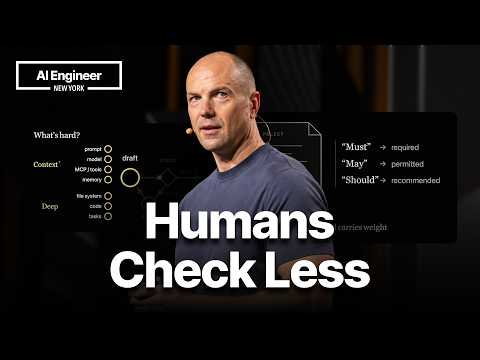
Name the task before trusting the agent
The video begins with the outcome and a policy at 00:00, then discusses a workflow graph at 04:05. That sequence matters. “This agent is trustworthy” is too broad a claim to test. “This version can triage a bounded queue of requests, recommend a response and escalate any request involving access changes” can be tested. The action boundary, not the agent's label, should determine how much supervision it needs.
GhostMesh's thesis: autonomy is an earned permission for a particular path, not a grade assigned to an agent. A model that performs well on a known class of routine work has earned evidence for that class under the evaluated tools and policy. It has not earned authority over a new destination, customer, account or consequence class. Versions and environments matter because a change in a tool, prompt, model or access control can invalidate the prior evaluation.
Kormos's workflow graph is a useful design artifact. It names stages and exit routes rather than presenting one long, opaque conversation. But a diagram of intended steps is not a record of what an agent actually did. The production trace must connect each request to the external system's readback. Otherwise the operator can see a green box in a dashboard while an unobserved write or duplicate event sits outside the model's story.
The loop needs an exit with authority
At 05:31, the discussion moves into the inner agent loop. More cycles can repair a bad answer, but they can also magnify a bad premise, spend a budget or repeatedly act on the same target. The loop should have a resource cap and a timeout, a clear completion criterion, a protected policy that it cannot edit, and a route to a human or a safe stop. For an effectful action, a stable idempotency key and a readback path matter more than the model's confidence that the first attempt succeeded.
The speaker's exception-flow discussion at 07:16 invites a hard question: which failures are visible? A tool timeout is not proof the tool did nothing. A downstream system might have committed the change and lost only its response. An unsupervised workflow should pause and reconcile that uncertainty, not make another attempt because the conversation contains no success message. A stop mechanism must be usable while the agent is running, not only after its report arrives.
Evidence earns scope, not certainty
At 10:43, evaluations become the proposed source of confidence. They can show whether a versioned workflow meets a defined acceptance test on sampled cases. They cannot certify all future inputs, tail events or a policy that changes after the test. A model judge may be useful for ranking a draft response; it should not be the sole witness for an unauthorized payment, data egress or access grant. The ground truth for such an action is the target system's state under an independently specified policy.
The strongest competing evidence against a simplistic “pass the eval, remove the human” rule is operational experience with long-lived agents. OpenAI describes novel failures seen during limited internal use of a long-running model and subsequent monitoring changes. Anthropic's autonomy study reports users shifting from individual approvals toward monitoring and intervention as they gain experience. Neither is a measurement of this Coinbase workflow. Together they sharpen the distinction between fewer clicks and less oversight: an expert may allow routine actions while keeping stronger interruption and retrospective inspection.
At 12:39, the video emphasizes bounded scope and fallback. GhostMesh would turn this into action tiers. Read-only summarization can often run with sampled quality review. Drafting an external message can be automated up to the send boundary. A reversible internal edit may need a diff and an easy rollback. A payment, credential change or public publication has a different consequence, and may retain an exact owner decision even when the rest of the workflow is fast. Sampling should be weighted by loss severity, not only event frequency.
Test the graduation path
The closing move at 14:29 is from supervised work to sampled monitoring and exception handling. It is a plausible operating progression, not a universal maturity score. To test it, pin a task suite, model, tools, policy and environment. Run the same cases under close supervision and under narrowly delegated execution. Include stale permissions, prompt injection, duplicate events, misleading tool messages, a failed network response after a committed write, and an operator cancellation during execution. Measure accepted outcomes, unauthorized effects, missed escalations, duplicate writes, recovery time, latency, human workload and false alarms by severity. Repeat after each material version change and on a held-out distribution.
If the proposed autonomy reduces human labor without widening unauthorized effects, extend one action tier. If the exception route fails a high-severity case, restore supervision for that edge even if aggregate accuracy looks excellent. A workflow is ready to work alone only for the exact acts its evidence covers, with an accountable operator still able to stop it and inspect its receipts.
 GHOSTMESH