01 The proposition
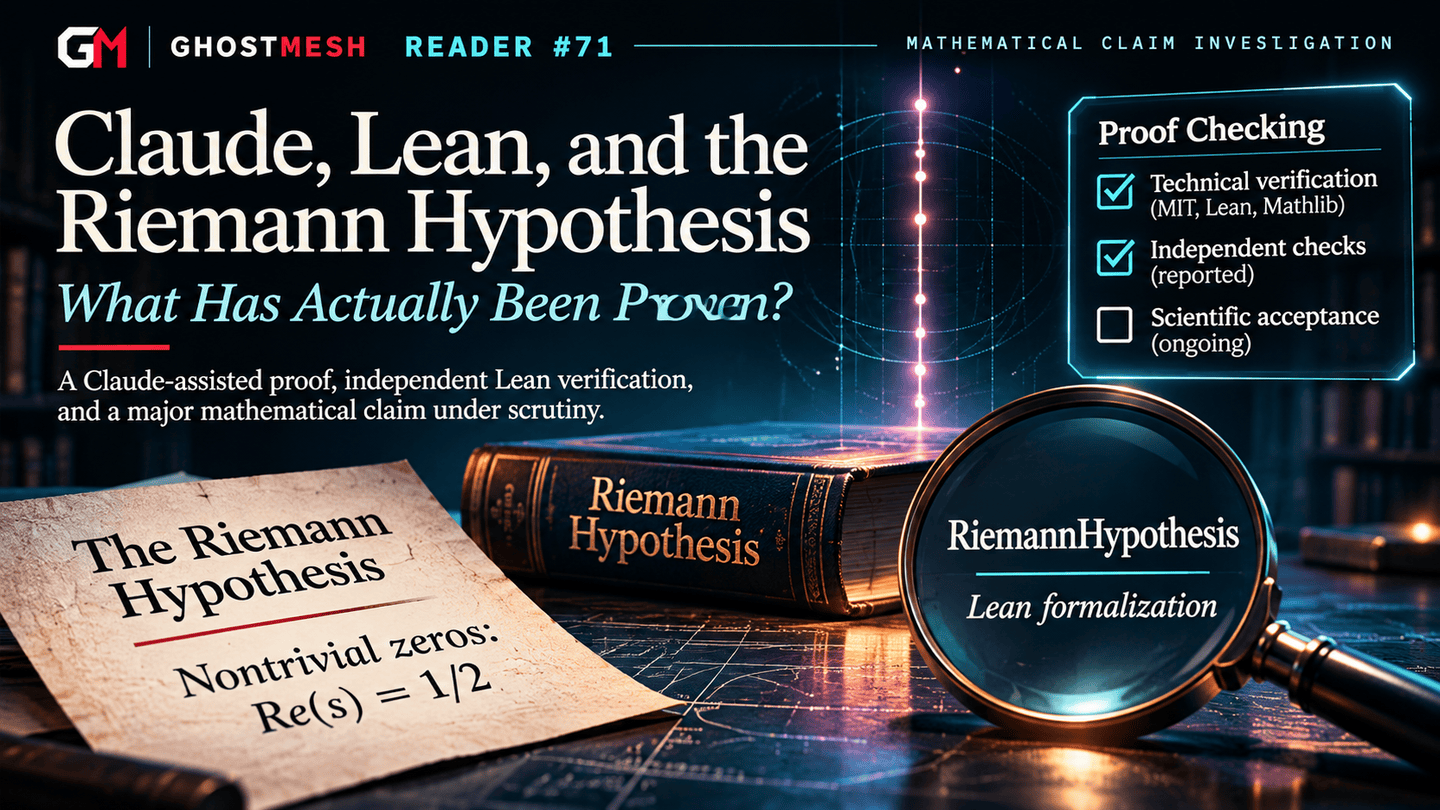
What exactly is the hypothesis?
Prime numbers become rarer as numbers grow, and the prime number
theorem gives their approximate distribution. The Riemann Hypothesis
(RH) is a much sharper claim connected to the zeros of the
complex-valued Riemann zeta function, usually written as a function of a
complex variable s. In the usual formulation, every nontrivial zero has
real part 1/2. The familiar trivial zeros lie at negative even integers;
the function has a pole at s = 1, not a zero. If correct, it constrains
error terms throughout analytic number theory.
Dirichlet’s Generalized Riemann Hypothesis (GRH) asks an analogous
critical-line question for the Dirichlet L-functions connected to
arithmetic progressions. It is stronger than classical RH. Alpöge’s note
also anticipates an Extended Riemann Hypothesis, but his
anticipated extension must not be reported as an already checked
theorem. Our source scope is classical RH plus Dirichlet GRH, with five
publicized top-level theorems.
02 The discovery account
What Alpöge and Claude say they did
Original announcement: Alpöge's November 20 note, author-reported discovery account.
Levent Alpöge announced on November 20 that he believed he had found
a proof with Claude. His note traces ideas from Stepanov-style methods
over function fields through Fourier analysis, automorphic forms, and
iterated theta lifts. He describes choosing the larger direction while
Claude supplied surprising technical moves, including a proposed chain
length roughly proportional to the square root of a summation scale.
The public statement is first-person testimony about the research
process, not a verified transcript of the Claude sessions. Alpöge says
he had the broader analogy and selected the mathematical setting, while
Claude suggested technical moves and far outpaced him near the finish.
Its account of who originated which idea should not be silently elevated
to an independently reconstructed authorship record. A chronological
outline supplied in the note is useful evidence of what the author
asserts, not a verified provenance trace for every human-AI exchange.
The 250,000-plus pages he mentions were an informal generated ‘book’ he
explicitly decided not to publish; that is not the 14-part Lean proof
artifact now being checked.
The meaningful deliverable is the Lean formalization, not the
emotional force of the announcement. Machines can present convincing
mathematical narratives and still be wrong. Proof assistants change the
question by requiring the kernel to accept a precisely stated sequence
of deductions. They do not automatically supply conceptual
understanding.
03 The formal evidence
Verification that matters
Source under evaluation: Alpöge's formal-proof announcement. Independent checker status is separately reported by MIT.
Andrew Sutherland of MIT maintains an independently reported
verification record with command outputs, software versions and artifact
hashes. As of November 21 at 12:55 UTC, its status is: Sutherland states he ran the checks with Claude Code. This is distinct from the submitter's work. nanoda and con-leche are independently implemented kernels, not two independent teams reproducing the mathematics or conducting a complete human argument audit.
None of these rows means GhostMesh executed the
check. They are Sutherland’s published results with timestamped
limits.
A crucial difference from a merely plausible proof sketch is the
statement-checking boundary. One exceptional detail is
easy to miss. The submitted
riemannHypothesis : RiemannHypothesis uses the definition
already present in Mathlib rather than a conveniently worded theorem
unique to Alpöge’s submission. The code’s formula quantifies over
complex zeros of riemannZeta and concludes the real part is
1/2 after excluding the trivial zeros and pole. This reduces a critical
false-proof risk: proving an easier proposition whose name resembles RH.
The independently checked statement comparison also strengthens
confidence in the target. Yet understanding the entire mathematical
construction and its significance is still a separate task.
Sutherland records caveats: the mass compilation was unsandboxed and
used direct lean invocations rather than a complete,
byte-for-byte confirmed lake build; dependencies and
kernels remain software trust boundaries; older checker binaries
declined unsupported features without formally rejecting the proof.
Those caveats deserve visibility, not a footnote that disappears under a
celebratory headline.
November 21 arithmetic consequence check (12:55 UTC). MIT reports that the classical RH proof combined with Robin1984 at commit acab1a3 yields Robin's divisor-sum inequality for n > 5,040 and Lagarias's for all positive integers. Compiled with only standard axioms; nanoda and con-leche accepted the combined export; con-leche's comparator matched both statements. The combined lake comparator remains RUNNING. These are classical RH consequences, not a separate team's proof, and not Dirichlet GRH or Extended RH. MIT source and dated results.
04 The trust boundary
What a proof checker proves, and what it does not
Formal verification has at least four layers. First, source code must
elaborate and compile. Second, the completed theorem must depend on
acceptable foundational axioms. Third, the checker or independently
implemented kernel must accept the deductions. Fourth, the proved
statement must faithfully correspond to the problem mathematicians meant
to solve.
The first three have strikingly strong MIT-reported evidence,
including independent implementations. The fourth has meaningful support
because Mathlib’s own statement is used and con-leche’s independent
comparator accepted all five challenge theorems. Broader mathematical
acceptance is not simply another CI job. It does not follow that journal
review is a fourth logical axiom: formal validity and the community’s
independent understanding are different kinds of evidence. Researchers
still need to understand the argument, test its definitions and
dependencies, compare methods, identify any hidden assumptions in
mathematical interpretation, and assess what new mathematics has
actually been obtained.
A proof need not be short or intuitively transparent to be valid. At
the same time, acceptance by a kernel is not a free pass to claim a
final solution to the world. A correct machine proof and a
comprehensible human explanation are different scientific artifacts.
05 The open questions
Three ways this could still change
Claims in the original submitted announcement remain distinct from independently reported check completion and community acceptance.
Technical completion. The MIT register has already
reported a clean compilation, standard axiom checks, Lean-module replay
and multiple independent checker acceptances, but its full
lake comparator and the default/paranoid Lean-kernel
full-export replay had no finished verdict at the cited time. They must
remain RUNNING, not be silently promoted from other
checks.
Mathematical interpretation. The statement matches
Mathlib’s native RH definition, and an independent checker compared the
five targets with a challenge export. The community can still
investigate dependencies, clarify arguments, and determine which ideas
are genuinely new. A successful proof object does not automatically
supply an intelligible mathematical proof narrative.
Discovery provenance. Alpöge’s description credits
Claude with essential technical steps. The machine-readable proof does
not itself identify which collaborator first proposed each idea. Claims
about AI creativity or autonomy require additional evidence beyond the
validity of the theorem.
06 The implications
What changes if the claim holds?
The immediate mathematics would be extraordinary: classical RH,
Dirichlet GRH, and a potentially new route across areas of number
theory. Some theorems presently conditional on GRH could then become
unconditional. But no general claim of instant encryption collapse
follows, and any application still demands its own technical
analysis.
The AI consequence might be even larger. Alpöge’s description
suggests not merely autocomplete for an existing proof but substantive
participation in exploring or assembling an argument beyond his own
immediate grasp. If the result survives and independent history of the
human/AI work supports that account, it challenges comfortable
assumptions about who must understand a proof during discovery, who is
entitled to authorship credit, and where warranted trust actually
resides.
If the claim fails, the failure mode would be equally valuable
evidence: formal statement mismatch, kernel limitation, imported
assumptions, provenance gaps, or a misinterpreted technical pass are
different classes of error. A serious Reader would preserve the causal
diagnosis rather than quietly erase the claim.
07 The operational lesson
A GhostMesh operating lesson
The system of record should not treat a founder, a mathematician, a
model vendor, a kernel, or a headline as unquestioned authority. Nor
does a successful kernel check prove a result is understood,
economically valuable, or correctly attributed to AI. It should track
exact claims, immutable sources, technical check receipts, independent
replication, expert interpretation, and explicit status transitions. The
reader should be able to see what moved from CLAIMED to FORMALLY
SUPPORTED, what remains RUNNING, and what still requires human
intellectual appraisal.
The analogy to engineering is not perfect: mathematical proof has an
unusually crisp formal target, while production systems face messy
operational environments. Yet the central discipline transfers. Model
confidence does not confer authority; inspectable evidence, appropriate
independent checks, and competent interpretation do.
Claims, counterevidence, and limits
- Claim: A complete classical RH and Dirichlet GRH
proof exists. Role: Alpöge’s claim, with strong
MIT-reported independent formal checks. Open: final
checks, broad mathematical understanding and acceptance.
- Claim: Claude provided critical novel steps.
Role: Alpöge’s testimony. Open:
external reconstruction of collaboration and causal credit.
- Claim: The theorem proved is really RH.
Role: MIT’s Mathlib definition and independent
comparator checks. Open: sustained mathematical
scrutiny.
- Claim: The claimed result immediately destroys
cryptography. Role: unsupported extrapolation.
Disposition: do not state.
- Claim: Extended RH is proved.
Role: unsupported by the scoped author note and MIT
register. Disposition: do not state.
- Claim: Clay has accepted or awarded a Millennium
Prize. Role: not established.
Disposition: do not state.
Source custody and limitations
Claim register / revision 2026-11-21
Corroboration & counterevidence
MIT independent verification as of 2026-11-21 12:55 UTC. All technical results are MIT-reported and not re-executed by GhostMesh. End-to-end Lean checks remain running.
Custody proves what was retained, not that a claim is true. Source assertions, vendor documentation, independent measurements and GhostMesh proposals have different evidentiary reach.
What would change the call? Review kernel or comparator rejection, nonstandard axioms, statement mismatch, faulty dependencies, a changed source archive, or a documented flaw in interpretation; publish timestamped revisions, not silent assertions.
Public sanitized evidence receipt. Review: accepted.
Claims under inspection
Open a claim to see its source location, support, counterevidence and limits.
Source or factual assertion Partially corroboratedAlpöge and Claude developed a complete proof of classical RH and Dirichlet GRH.
Source or factual assertion Partially corroboratedThe published Lean submission compiles 175,187 modules and depends only on standard Lean axioms.
Claim ID: r71-compilation. As of 2026-11-21. Kind: technical-report. Mapped source location: III / table
Supporting evidence type: independent-technical-report. Counterevidence type: None qualified. These labels describe the mapped record, not an article-wide verification score.
MIT reports successful compilation of all modules, zero errors, only three standard axioms and independent module replay.
Limits: The report is third-party verified but not reproduced by GhostMesh. The build was unsandboxed and not a complete byte-for-byte lake build.
Supporting evidence: MIT Mathematics: Verification files for the Lean proof of the Riemann Hypothesis
Counterevidence / constraints: None qualified
Source or factual assertion Partially corroboratedIndependent nanoda and con-leche kernels accept the full exported proof.
Claim ID: r71-kernels. As of 2026-11-21. Kind: technical-report. Mapped source location: III / table
Supporting evidence type: independent-technical-report. Counterevidence type: None qualified. These labels describe the mapped record, not an article-wide verification score.
MIT reports acceptance by two separate kernel implementations and comparison of the five statements against the independent challenge.
Limits: This is independent checker implementation, not separate mathematical research-team replication or comprehensive human audit.
Supporting evidence: MIT Mathematics: Verification files for the Lean proof of the Riemann Hypothesis
Counterevidence / constraints: None qualified
Source or factual assertion Partially corroboratedThe classical RH theorem targets Mathlib native RiemannHypothesis, while scoped GRH concerns Dirichlet L-functions.
Claim ID: r71-statement. As of 2026-11-21. Kind: technical-report. Mapped source location: I and III
Supporting evidence type: independent-technical-report. Counterevidence type: None qualified. These labels describe the mapped record, not an article-wide verification score.
The source inspection reports Mathlib statement and five challenge comparisons with explicit Dirichlet scope.
Limits: Extended RH, Dedekind zeta and Hecke L-functions are outside the verified claim.
Supporting evidence: MIT Mathematics: Verification files for the Lean proof of the Riemann Hypothesis
Counterevidence / constraints: None qualified
Source or factual assertion Partially corroboratedThe submitted classical RH proof implies Robin and Lagarias inequalities when combined with Robin1984.
Claim ID: r71-arithmetic. As of 2026-11-21. Kind: technical-report. Mapped source location: III / arithmetic consequences
Supporting evidence type: independent-technical-report. Counterevidence type: None qualified. These labels describe the mapped record, not an article-wide verification score.
MIT reports successful combined compilation, standard-axiom audit and independent nanoda/con-leche acceptance of both divisor-sum theorems.
Limits: This is an arithmetic cross-check using a separate formalization, not an independent new proof; combined lake comparator still running.
Supporting evidence: MIT Mathematics: Verification files for the Lean proof of the Riemann Hypothesis
Counterevidence / constraints: None qualified
Source or factual assertion UnverifiedClaude made the decisive creative steps in Alpöge’s discovery.
Claim ID: r71-attribution. As of 2026-11-21. Kind: author-attribution. Mapped source location: II
Supporting evidence type: author-original. Counterevidence type: None qualified. These labels describe the mapped record, not an article-wide verification score.
The original author credits Claude for significant technical moves.
Limits: Formal proof objects do not establish who first proposed individual ideas or provide a session-by-session verified provenance.
Supporting evidence: Alpöge: Alpöge original Riemann Hypothesis announcement
Counterevidence / constraints: None qualified
External references and independence
Levent Alpöge · Alpöge · Published 2026-11-20; last update not specified. Source date as given in the inspected record. Event / measurement: Not specified; do not substitute publication date. Checked 2026-11-21T14:32:00Z.
Location: Original four-page announcement. Type: author-original. Author assertion; no independent reconstruction of model exchanges.
Andrew Sutherland · MIT Mathematics · Published 2026-11-21; last update not specified. Source date as given in the inspected record. Event / measurement: Not specified; do not substitute publication date. Checked 2026-11-21T14:32:00Z.
Location: Summary, five top-level statements, arithmetic consequences, caveats. Type: independent-technical-report. Sutherland ran third-party verification with Claude Code. Independent kernels are distinct implementations, not second teams discovering the proof.
Nature reporting staff · Nature · Published unknown; last update not specified. Original publication date not established from retained record. Event / measurement: Not specified; do not substitute publication date. Checked 2026-11-21T14:32:00Z.
Location: Expert commentary including Andrew Granville. Type: independent-journalism. Journalistic and expert interpretation, not a substitute for kernel execution or a formal mathematical counterexample.
Clay Mathematics Institute · Clay Mathematics Institute · Published unknown; last update not specified. Original publication date not established from retained record. Event / measurement: Not specified; do not substitute publication date. Checked 2026-11-21T14:32:00Z.
Location: Official listed status. Type: institutional-status. Clay listing is institutional status, not a computational refutation or check of the submitted formalism.
Clay Mathematics Institute · Clay Mathematics Institute · Published unknown; last update not specified. Original publication date not established from retained record. Event / measurement: Not specified; do not substitute publication date. Checked 2026-11-21T14:32:00Z.
Location: Official prize criteria. Type: institutional-rules. Prize rules concern formal recognition, not the Lean theorem or mathematical validity.
SharePlane Work comparison
Separately reviewed editorial connections, not independent validation of the video.
- companionClear Thinking Is the Control PlaneThis published SharePlane essay examines why apparent AI success is not enough: claims, evaluations, independent evidence and human judgment must be separated. Reader 71 applies that discipline to proof objects and mathematical acceptance.
- companionArtifact GraphThe published SharePlane Work explains how claim, source, provenance and receipt links preserve inspectable knowledge. Reader 71 uses that same source/claim architecture to distinguish author testimony, formal-checker reports and institutional recognition.
Source and verification record
Author note: Alpöge’s original announcement (PDF) (November 20, 2026; archived
privately, SHA-256
3fc97784b71ddd44ff8aa0a177e99622a1c61b13cfa843a0989ee4a7a0cfeb8d).
Independent technical register: Sutherland’s MIT verification record
(Andrew Sutherland, snapshot updated November 21, 2026, 12:55 UTC). See
the companion machine-readable private evidence register for each
reported status.
Independent reporting:
Nature report, including Andrew Granville’s criticism of interpretability (media context and
expert caution, not kernel verification).
Official prize/institutional status:
Clay Riemann Hypothesis status and
Clay prize rules.
The retained November 20 MIT snapshot was byte-for-byte unchanged at the original retrieval, with SHA-256
de7153ec1b22acab193a99824d427d41050e2c0d2c4374ec518d52fc0de62307.
This is a source refresh, not a fresh technical check.
All evidence status claims above are as of the named source
snapshot. Future updates must cite the later timestamp, retain the earlier recorded status, and publish an explicit evidence revision if the verification conclusions change.
 GHOSTMESH